hormuz breakout: the 2026 news cycle as a brick wall.
A satirical political-cartoon Breakout set during the 2026 USA-Iran crisis. Eight chapters. Twelve leaders. I made it during the war. We must laugh or we will cry.
by Ori Iscovici
A satirical political-cartoon Breakout set during the 2026 USA-Iran crisis. Eight chapters. Twelve leaders. I made it during the war. We must laugh or we’ll cry.
What is Hormuz Breakout?
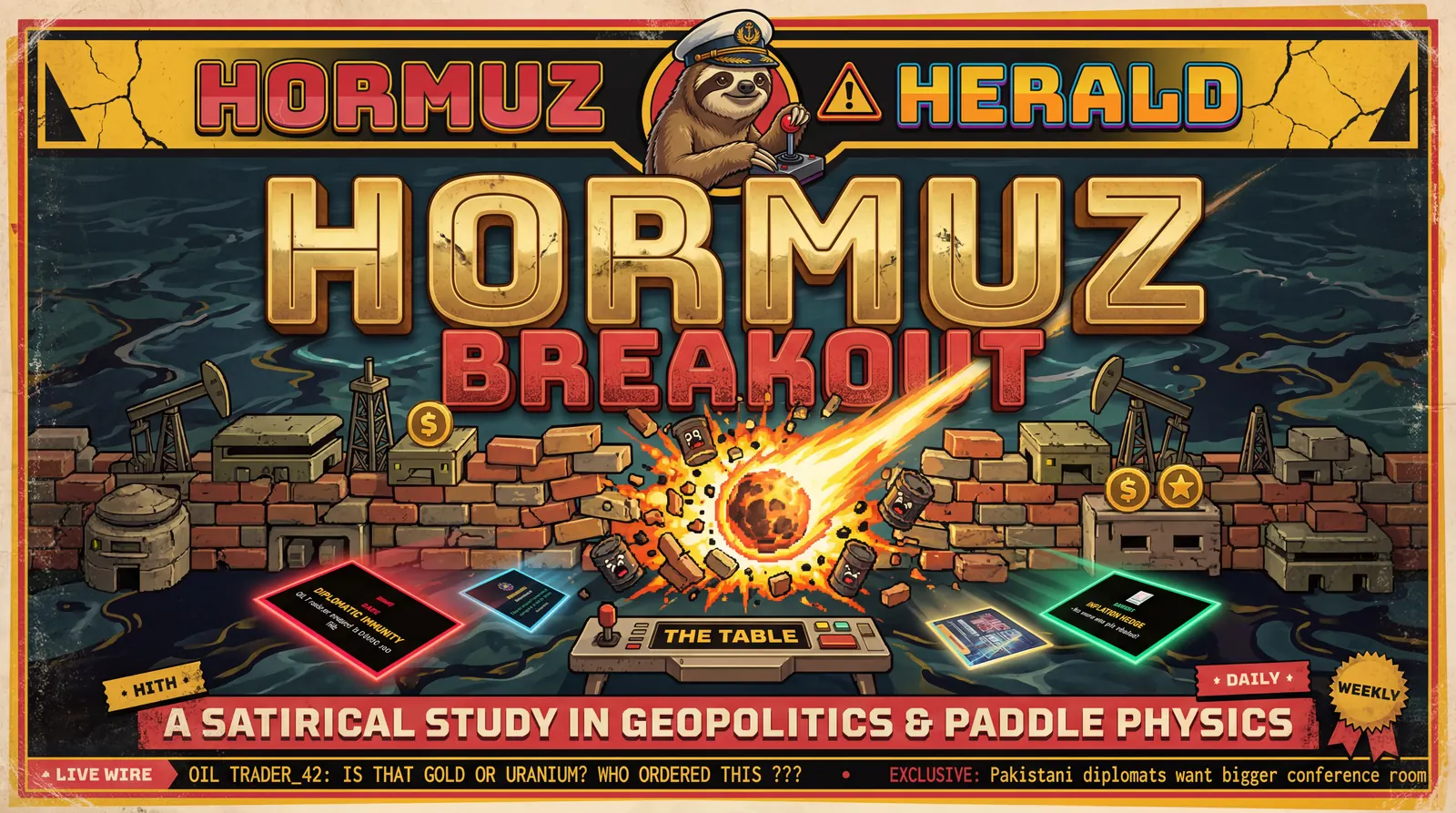
Hormuz Breakout is a free browser game built on the bones of the 1976 Atari classic Breakout — a paddle, a ball, a wall of bricks — and dressed up as a political cartoon about the 2026 USA-Iran crisis. Eight chapters. Twelve playable leaders. Twenty-eight between-chapter upgrades. The Strait of Hormuz, blockaded and unblocked, a hundred different ways.
It is, mostly, a Breakout game. It plays like a Breakout game. The brick wall is in front of you. The ball bounces. You move the paddle. You hit the ball back. The bricks crack. The wall comes down. The next chapter loads.
But the bricks are headlines. The bosses are caricatures. The “achievements” are codex entries that unlock the actual lore as you play. The combo quips that pop up after a long volley are written in the voice of a tired political commentator who’s been on the cable-news circuit too long. It’s a Breakout game made in 2026, by someone who has been reading the news in 2026.
Wait, the war as a Breakout game?
Yes. Two things to say about that.
One: the conflict is real. The Strait of Hormuz blockade is real. The civilian cost is real. I’m Israeli. While I built this, my eight-months-pregnant wife and I were running to shelters during incoming barrages. There is no part of this I built from a comfortable distance.
Two: the game is not an op-ed. It doesn’t push a position. It doesn’t lecture. It is a vehicle for laughing at things you would otherwise cry about, which is a thing humans have done with their wars for as long as we’ve had wars. There is a long tradition of political cartoons being the only sane response to a moment that has lost the plot. Hormuz Breakout sits in that tradition, with a paddle.
If you came looking for a take, the take is: we must laugh or we’ll cry.
How does it play?
Like Breakout. Mouse to move the paddle, click to launch the ball, don’t drop it. The wall has six brick types — concrete, glass, fortified, explosive, ricochet, gold — each behaving differently. Some take two hits. Some break the ball’s angle. Some chain into others.
Each of the eight chapters is one wall, plus a leader you pick at the start of the run. The leader buffs different stats: paddle width, ball speed, brick damage, lives, combo bonus. After each chapter you get a choice of three upgrades, drafted from a pool of twenty-eight. Standard arcade-roguelike loop.
The whole run takes between twenty and forty minutes, depending on how many chapters you survive and how mean the random-upgrade RNG is on a given seed.
The chapters, the leaders, the codex
Eight chapters trace the diplomatic and military arc of the 2026 crisis: the blockade, the negotiations, the carrier deployment, the proxy strikes, the strait reopening. Each chapter has a wall layout drawn from real headlines and a brief flavor scrawl from the perspective of a fictional cable-news anchor losing his mind in real time.
Twelve leaders span the players in the actual conflict — the American, the Iranian, the Israeli, the Russian, the Chinese, the Turkish, the European Union as a single irritated bureaucrat. Each plays differently. Each has a unique line they say after a game over.
The codex unlocks as you play. Every fifty bricks, every boss kill, every chapter clear adds an entry. It’s where the actual jokes live — and where, if you read carefully, the actual writing about the war lives too.
On laughing during a war
There’s a temptation, when you make a thing during a hard time, to either be too serious about it (and make something that’s only sad) or to dodge the seriousness entirely (and make something that pretends nothing is happening).
I don’t think either is right. The right move, for me, was to make the serious thing into a Breakout game. To make the Strait of Hormuz a level layout. To put the headlines in the bricks where you have to break them yourself. To make the player the agent, instead of the witness.
I don’t think Hormuz Breakout makes anyone feel better about the war. I think it lets them feel something else about the war for twenty minutes, which is a thing I needed at the time, which is why I built it.
If you’re somewhere safe, play it like a satire. If you’re in a shelter, play it like a way to pass the next forty minutes.
Is it free?
Yes. No install, no signup, no ads. Open the page, click “tap to play.”
Where to play
Hormuz Breakout is free in your browser. Run length: 20–40 minutes. Best on desktop. Plays on mobile. Best leader for a first run is the European bureaucrat — gentle stat curve, the dialogue is the funniest.
— Ori