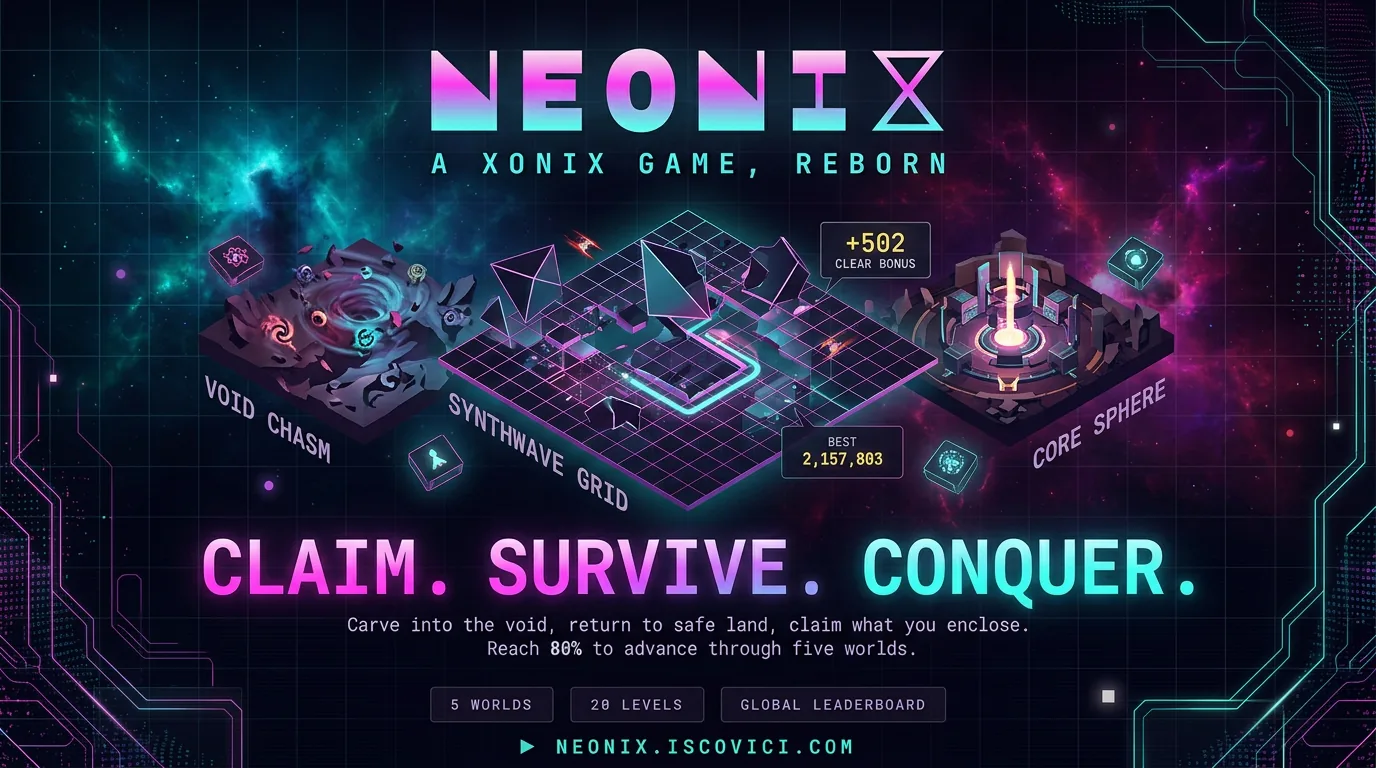
neonix: the xonix you remember, the way you remember it.
A 2026 synthwave reimagining of the 1984 arcade classic. Free in browser. Made by me, with the music. It might be my favorite thing I have ever shipped.
by Ori Iscovici
A 2026 synthwave reimagining of the 1984 arcade classic. Free in browser. Made by me, with the music. It might be my favorite thing I have ever shipped.
What is Neonix?
Neonix is a free browser game that takes the core mechanic of Xonix — a 1984 arcade classic where you carve off territory by drawing lines while enemies chase you — and rebuilds it for 2026 with a synthwave aesthetic, modern controls, original music, and a few quietly cruel modern touches.
If you’ve never played Xonix: think Pong’s geometric severity, but you’re claiming land. You start with two enemies bouncing inside a rectangle. You move along the rectangle’s edge. When you push inward you start drawing a line; if you complete it back to the edge, every cell on the smaller side of the line gets claimed for you, the enemies bounce around the bigger side, and the rectangle just got smaller. You win the level when you’ve claimed enough land. You die if an enemy hits you while you’re mid-line — while you’re vulnerable.
That’s the whole game. It’s older than I am. It’s still better than most things in the App Store.
The original was better than it had any right to be
I played Xonix on a beige IBM clone in the early nineties. It was on a 5.25”
floppy with about forty other games my dad had pirated, none of which had
labels. You memorized them by where they sat in the directory listing. Xonix
was around D:\GAMES\X\.
The reason it stuck is that the risk in Xonix is unique. Most arcade games of its era — Pac-Man, Galaga, Asteroids — have a clean state machine: alive or dead, and the difference is “did the bad guy hit you.” Xonix has a third state: you’re drawing. You’re committed. The longer your line, the more land you’re going to claim — and the more time you’re spending exposed. You can’t take it back. You can’t dodge. The only safe move is “don’t draw” — and that move means you don’t progress.
That’s a real feeling. It’s the same feeling as making a phone call you’ve been avoiding, or sending a text you can’t unsend. It maps onto something humans actually do. And it’s all in a 16-color tile grid.
Why neon, why now
I almost made Neonix in a brutalist black-and-white style — it would’ve matched the Wikipedia screenshots of the original. I built a prototype like that. It looked great in a screenshot. It was lifeless to play.
So I went the other direction. Synthwave. Magenta on purple. A horizon line. A grid that pulses faintly with the music. Trail particles that dissolve. Every collision is a synth stab.
The aesthetic isn’t decoration — it’s load-bearing. Xonix at sixty frames a second, with reactive audio and bloom on the trail, feels different from Xonix on a CGA monitor. The mechanic is identical, but the texture wraps the player in a different state. The neon makes you feel like you’re inside a song, not on a grid. That changes how you play.
The music
I made the soundtrack myself. There’s an underscore that loops at ~92 BPM and four stingers — claim, miss, near-miss, level-clear — synced to the underscore so the rhythmic punch lands every time, instead of fighting the track.
I’m not a composer. I’ve made loops for fun for years, but never for a game I shipped. Doing it for Neonix taught me that game music is a different discipline: you’re not writing a song, you’re writing a state. The track has to support thirty seconds of careful play and three seconds of “oh god I’m dying” without changing keys. Most of my time on the soundtrack was spent making it more boring on purpose, so the stingers could do the work.
If no one ever plays Neonix again, I will still listen to its soundtrack on long walks.
How do you actually play?
Mouse, arrow keys, or — on mobile — tapping the edge of the playfield in the direction you want to go. Pushing inward starts a line. Returning to the edge claims everything on the smaller side. Win condition: claim 75% of the playfield. Lose condition: an enemy touches your active line, or touches you mid-line.
The first two levels are gentle. By level five there are four enemies, and you start to understand that the game’s real difficulty curve is spatial: the smaller the open area gets, the less room you have to draw long lines safely, but the more land each square represents. Late-game Xonix becomes a game of tiny, vicious cuts.
Is Neonix free?
Yes. No signup. No install. No ads. Open the page, click “tap to play,” and you’re in. It runs on phones, tablets, laptops, and the kind of dusty Chromebook your high school still issues to students. If your machine can render a 60fps grid, Neonix runs on it.
What’s still coming
Right now Neonix is single-player, single-session. That’s deliberate — I wanted the launch to feel like the original. There’s a lot of room left, though:
- Time attack. A 90-second countdown, a daily seed, a leaderboard. Same mechanic, completely different game.
- Score mode. Combo multipliers for fast claims, risk multipliers for long lines. The kind of thing that turns an arcade game into a habit.
- Versus. Two players, one playfield, both drawing. I have a half-built prototype. It’s mean.
None of this is on a published roadmap. I’ll ship them when they feel right.
Where to play
Neonix is free in your browser. Try the first two levels with the sound on. If you played the original in 1984, try to beat level six on your first run. I have not.
— Ori